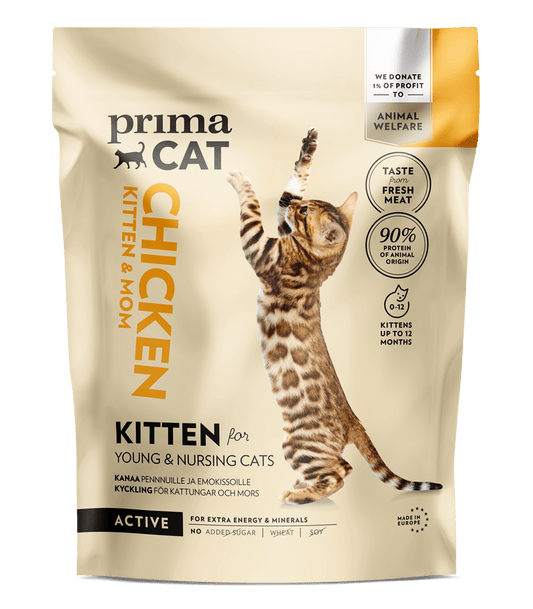
With kitten food, your little fluffball grows like crazy
To warmly welcome your new, fluffy family member, you roll out the red carpet. Complex wall constructions, a scratching post, and countless toys; only the best is good enough for your mini house tiger. And at Prima Diervoeding, we understand that very well.
But did you know that healthy
kitten food is also essential for the happiness of your little furry friend?
At Prima Diervoeding, we always strive for healthy and happy cats at every stage of life.
Why choose kitten food?
In the first year of life, your kitten still needs to grow a lot; the nutritional needs are therefore different from those of an adult cat.
Because kitten food is specially tailored to the needs of your little fluffball, it’s a good idea to delight your little adventurer with healthy kitten food.
Which nutrients are essential?
To grow into a healthy, mischievous cat, your kitten needs plenty of energy. Your little house tiger mainly gets this from fats, proteins, and carbohydrates.
You might think: ‘adult cat food also contains (animal) proteins, right?’ That’s true, but kitten food contains more (animal) proteins in comparison. And that’s for a good reason, as these support healthy development and assist your kitten during its growth phase.
The right amount of vitamins and minerals — such as phosphorus, calcium, magnesium, zinc, and iron — should also not be missing in kitten food; these ensure good muscle development, strong bones, and healthy vital functions.
Avoid artificial preservatives
Make sure the kitten food contains no artificial preservatives. BHA and BHT are the most commonly used agents to extend shelf life. Fortunately, there are now natural alternatives, such as vitamin E and vitamin C.
At Prima Diervoeding, we also use natural preservatives, including vitamin E.
Taurine must not be missing
Taurine is an essential nutrient that most animals produce themselves. However, cats are an exception to this rule; our house tigers naturally do not produce taurine.
For the health of your kitten (and adult cat), it is necessary that the food contains enough taurine. This supports the growth of the nervous system, the development of heart function, and vision.
Compared to adult cats, kittens need more taurine. For this reason, kitten food contains a higher amount of taurine.
A taurine deficiency can lead to serious health problems, including blindness, heart muscle diseases, and a weakened immune system.
Which food is not suitable for your kitten?
Does your fluffy housemate look at you pleadingly while you enjoy your dinner? Then — as hard as it may be — do not give your kitten any leftovers. Especially herbs, raw fish and/or meat, and bones/shanks are a no-go. Your little adventurer is not able to digest herbs, and raw meat and/or fish can contain salmonella. Because there is a risk that pieces may get stuck in the throat, we also recommend not giving your kitten cooked bones and/or shanks.
In short, give your mini house tiger only kitten food; your little friend doesn’t need anything more.
What amount is allowed?
Don’t give in to the urge to overfeed your kitten; instead, follow the feeding table stated on the packaging. Make sure to divide this amount into small portions and give them to your fluffball at fixed times. This way, your kitten learns to get used to structure and you avoid overweight.
Note: cats are naturally not good drinkers. Therefore, give your little adventurer enough drinking water to prevent dehydration.
When can you switch your little friend to solid food?
Kittens are switched to solid food between four and eight weeks; since this already happens at the breeder — kittens may only leave the mother from eight weeks — you don’t have to do this yourself as a cat owner.
But if you have a litter of kittens yourself, it’s important to switch the little rascals properly. As mentioned above, this should happen between four and eight weeks. You first let the kittens get used to solid kitten food, while they often still drink milk from the mother cat. Only when the little ones are fully accustomed to solid kitten kibble or the mother refuses to let them drink, do they switch completely to solid kitten food. Note: kittens must already be on solid food when they leave the nest.
Let your kitten get used to the kibble
It may be that your little fluffball needs to get used to the harder texture of the kitten kibble at first. In that case, soak the kibble (briefly) in lukewarm water to soften it. Bet your mini house tiger will eat the kibble now!
How long before your kitten can switch to adult food?
Generally, you can switch your fluffball to adult cat food after 12 months. For large cats — such as Maine Coons and Norwegian Forest Cats — wait a few more months before doing so; these breeds mature a few months later. Larger cats often switch only at around 15 months of age.
With Prima Diervoeding’s range, you cater to your cat’s every wish
Whether you want to surprise your little rascal, furry cat teenager, or allergic cat with healthy and tasty food; at Prima Diervoeding, you’ll find something for every cat! Our range varies from
dry food,
wet food to
grain-free cat food.